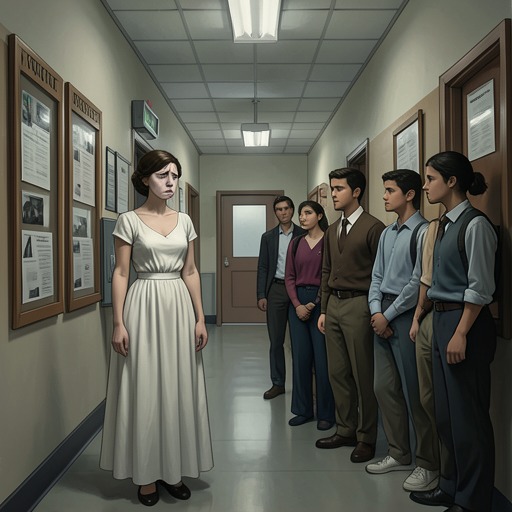
Mike’s visit to Phyllida Trounce
Night TrainMike Hoolihan’s visit to Phyllida Trounce turns a quiet interview into a consequential check on the days before Jennifer Rockwell’s death: Phyllida confirms that Jennifer visited on the preceding Thursday, then estimates that six stabilizer pills are missing. The scene offers Mike a concrete lead, but not a complete explanation; its force lies in the gap between a number that can be counted and a death whose meaning remains uncertain.
Background and the Question of the Visit
Mike asks Phyllida whether she and Jennifer had lost touch. Phyllida says they had written to each other for a time, though she was not someone who went out much. That history makes Jennifer’s appearance at Phyllida’s home notable, and Mike presses the point: Jennifer came to see her in the week before she died. Phyllida confirms that the visit took place on the Thursday before the death.
The answer arrives after a pause that Mike renders as far longer than a few dots on the page. He compares its delay to an international phone call from years earlier, with an echo-free lag that makes a person begin repeating a question just as the answer finally comes through. The comparison gives the exchange its pace: the information is simple, but extracting it feels laborious. Mike’s narration also records how quickly he turns from waiting for Phyllida’s answer to forming his own explanation. He tells himself that he knows why Jennifer killed herself because she had set foot in this place. That is Mike’s immediate suspicion, not a finding established by the visit.
The House and Its Occupants
The room is dusty and cold. Phyllida sits upright in a chair, her thin, straight brown hair and distant gaze recalling a photograph Mike has seen in Jennifer’s apartment, though in person she seems more worn. The comparison connects the scene to the absent Jennifer while keeping the two women distinct: Mike recognizes the likeness in Phyllida’s posture and appearance, but sees her now in the exhausted present of her own home.
Other people are there, though neither becomes part of the conversation. A fair-haired man of about thirty, with a balding mustache, wears earphones and attends to their steady buzz; he neither speaks nor looks toward Mike. In another room, Phyllida’s stepmother moves about, stumbling and groaning as obstacles impede her. Mike hears her fatigue without seeing her. These quiet, separate presences frame the interview as an encounter conducted amid other people’s private conditions, not in an empty or controlled room. Mike’s attention moves among Phyllida, the man’s unbroken listening, and the stepmother’s weary sounds, while the investigation remains focused on Jennifer.
The Medication Check
Mike asks whether Phyllida keeps a chart of her pills and a roster of the doses, then suggests the kind of compartmented pill box that separates medication by time. Phyllida nods. He asks her to count the stabilizers, naming Tegretol as an example while leaving the exact medication uncertain. The request turns the conversation from the history of Jennifer’s visit to a count that might bear on what happened before her death.
While Phyllida is away counting, Mike stays in the room. The man’s earphones continue to buzz, and the stepmother continues to stumble and groan in the back room. Mike describes the sound of the headphones through his own bleak association with mental illness, then reacts aloud to the stepmother’s condition. He moves to the window, where the rain is falling, and makes himself a promise whose meaning he does not explain. The pause matters because no new answer has arrived: Mike waits among these sounds, aware of distress around him but unable to turn it into a settled account of Jennifer.
Phyllida returns down the passage, and Mike calls out to ask how many pills are missing, offering five or six as possibilities. She answers that she thinks six. Mike leaves immediately. Her estimate is the visit’s sharpest result, but it remains an estimate: the scene does not identify who removed the pills, when they went missing, or whether Jennifer took them. Nor does it establish that the count explains her death.
Investigative Significance
The visit produces two pieces of information with different degrees of certainty. Phyllida places Jennifer at her home on the Thursday before the death; the pill count yields a tentative figure of six missing stabilizers. The first is a confirmed recollection, while the second is Phyllida’s qualified response to Mike’s request. Keeping that distinction matters: Mike’s suspicion gathers force, but the evidence shown here does not prove what Jennifer did or why.
The scene also sets Mike’s professional search for particulars against the temptation to make a whole explanation out of them. He asks about a date, a medication chart, and a count; at the same time, his mind leaps toward certainty before the count is even returned. His swift departure after hearing the number gives the answer the momentum of a lead, not the completeness of a resolution. Phyllida’s visit with Jennifer and the missing pills therefore deepen the inquiry while preserving its central uncertainty.